

Clinical Governance
What is Clinical Governance?
Clinical governance describes the accountability of pharmacy owners in ensuring that there is a strong culture and appropriate systems and processes in place to support the safety, quality and continuous improvement of all activities and services provided in or from a community pharmacy.
It involves relevant and appropriate relationships and responsibilities to be established between pharmacy owners, their staff, patients, consumers and other stakeholders to support good clinical outcomes for patients. It ensures that community pharmacies and their patients can be confident that systems are in place to deliver safe, quality and patient centred health care.
Clinical governance is how a pharmacy knows that the care it provides is safe, effective, consistent, and improves over time.
It is reflected in everyday practice: how risks are identified and managed, how incidents and near misses are used for learning, how staff are supported to provide safe care, how patients are involved in decisions, and how the pharmacy continually looks for opportunities to improve.
As community pharmacy practice continues to evolve, strong clinical governance provides the systems, processes and culture that support safe, consistent and patient-centred care across dispensing, professional services and other areas of practice.
Supporting QSPP through strong clinical governance
From 1 October 2026, QSPP replaces QCPP for community pharmacy accreditation. Clinical governance is central to QSPP, with a stronger focus on how pharmacies demonstrate that patient safety, quality and continuous improvement are embedded in everyday practice. This means having clear systems to manage risk, support the pharmacy team, learn from incidents and feedback, and continually monitor and improve the care provided.
Clinical governance does not need to be complicated. Start with what your pharmacy already does well, identify the areas that present the greatest risk or opportunity for improvement, make responsibilities clear, and check whether the changes you make are working.
While pharmacy owners are ultimately accountable for clinical governance, every member of the pharmacy team contributes to the delivery of safe, quality care and continuous improvement.
What does good clinical governance look like?
Clinical governance is not something a pharmacy does only when accreditation is approaching. It is how safe and quality care is led, delivered, monitored and improved every day.
The National Model Clinical Governance Framework, developed by the Australian Commission on Safety and Quality in Health Care (ACSQHC), outlines the essential elements of effective clinical governance systems. These elements provide a foundation for health service organisations, including community pharmacies, to deliver safe, high-quality care and drive continuous improvement.
For community pharmacy, the Australian Community Pharmacy Standard (AS85000:2024) sets out requirements for clinical governance, supported through accreditation under the Quality and Safety Pharmacy Program (QSPP).
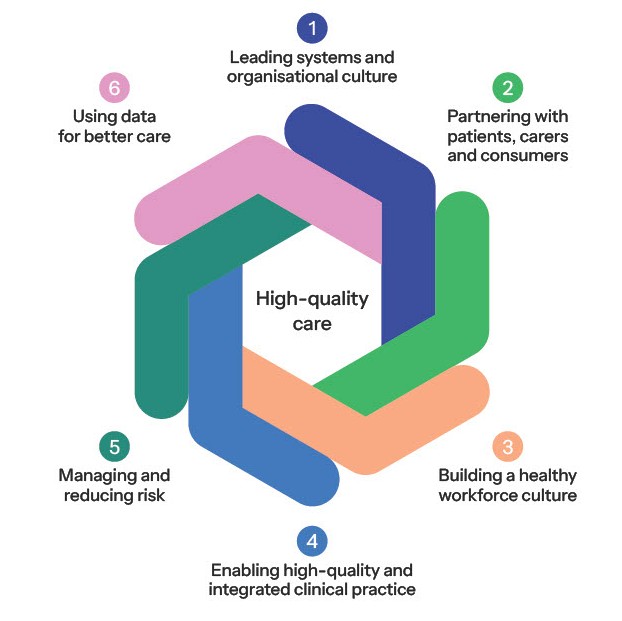
Source: Australian Commission on Safety and Quality in Health Care, National Model for Clinical Governance (2026)

A clinical governance cycle for community pharmacy
Putting this into practice, the Guild’s clinical governance cycle provides a practical approach for pharmacy teams to embed clinical governance into everyday practice. It helps teams turn risks, incidents, feedback and opportunities for improvement into safer, higher-quality care. The cycle involves identifying and recording issues, understanding why they occurred, making improvements, supporting the team to put changes into practice, and monitoring whether those changes are effective. The cycle is then repeated, supporting continuous learning and improvement as part of everyday pharmacy practice.
Guild members can access practical resources below to further explore and support implementation of the Clinical Governance Cycle.
High-quality care
- Everyone understands their role in keeping patients safe
- Policies, procedures and referral pathways are accessible and used in practice
- Risks are identified and managed before harm occurs
- Data from incidents, feedback, audits and other sources is used to identify trends, monitor care and guide improvements
- Staff are supported to speak up and maintain their skills and competence
- Patients and carers are genuine partners in their care
- Feedback, audits and other information are used to improve services
- Improvements are followed up to make sure they are working
- Leaders set clear expectations for safe, high-quality care, and everyone understands their role in achieving it
- Clinical care is evidence-based and coordinated, with clear procedures and referral pathways that are used in practice
Clinical governance support for Guild members
The Guild is consistently developing practical resources to help pharmacy owners, pharmacists and pharmacy teams understand, assess and strengthen clinical governance in everyday practice, and to support the transition to QSPP.
Related


Contact us
For questions or feedback about clinical governance resources, contact us at


Page last updated on: 06 November 2026